
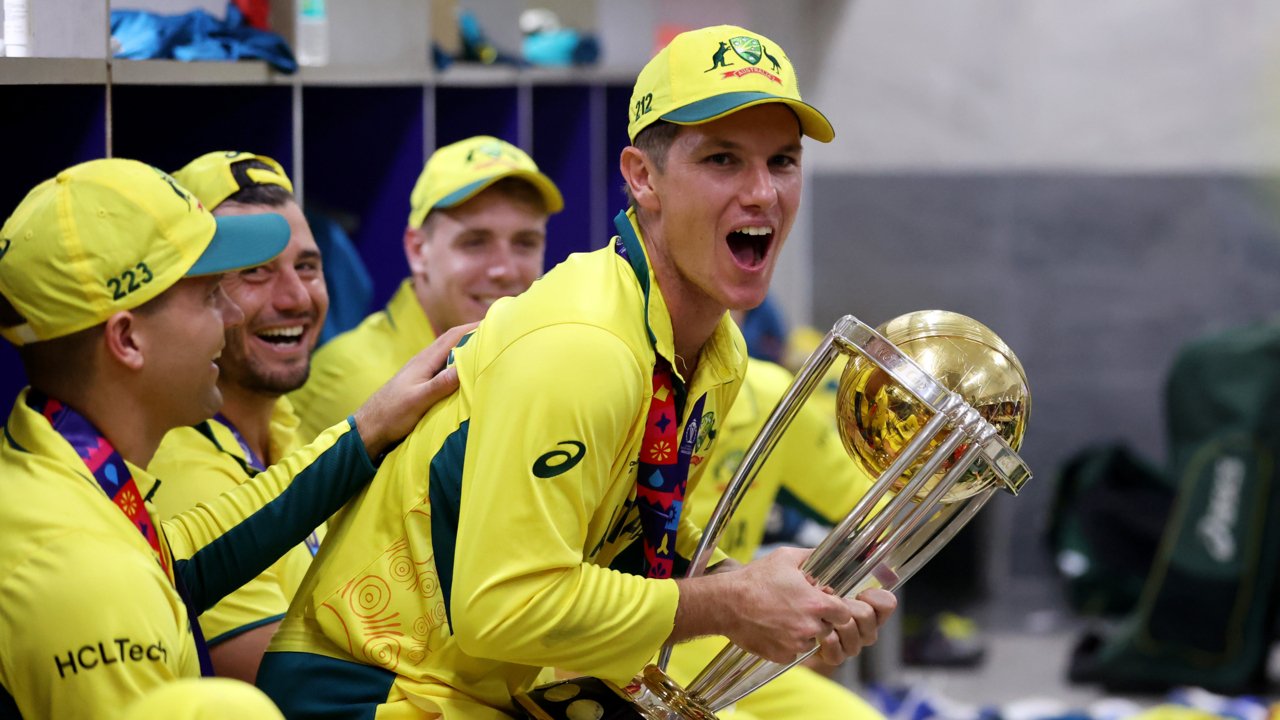
After the ICC decided to extend the competition with a new format earlier this month, Australia’s 2023 World Cup winning coach Andrew McDonald has urged for larger squad sizes at the 2027 ODI World Cup.
The 2027 ODI World Cup, which will be co-hosted by South Africa, Zimbabwe, and Namibia, will include 14 teams, a Super Series round prior to the group stages, and a new Super 7 prior to the semi-finals, according to an announcement made by the ICC two weeks ago. This is different from the 10-team ODI World Cup that Australia won in India in 2023.
Australia participated in eleven games in that competition, comprising nine group matches, a semifinal, and a final. A minimum of 13 games, comprising five group games, six Super 7 games, a semifinal, and a final, must be played by the 2027 event winner.
If one of the bottom three teams that compete in the tournament’s two-match “super series” advances to the final, the winner might have to play fifteen games.
After managing injury problems within their squad during the 2019 and 2023 editions as well as the 2022, 2024, and 2026 T20 World Cups, Australia has long advocated for greater squad sizes during World Cups.
McDonald said 15-player squads can be risky, as injuries to key players like Travis Head and Kane Williamson left teams with only 12-13 options in the last World Cup, affecting team balance and adaptability across changing conditions.
Australia decided not to replace Head in the squad when he broke his finger in the lead-up to the 2023 World Cup since medical personnel were supposed to clear him halfway through. According to ICC regulations, a player cannot be dropped out of the 15-man roster and return halfway through the competition in lieu of another unless the technical committee of the tournament approves their replacement due to an injury.
Instead, Australia played five games with just 14 healthy players after starting the tournament with Head in their 15. As a result, they decided not to include a second specialist spinner in the team and took a chance that Adam Zampa wouldn’t sustain an injury.
The risk paid off, as Head scored a century in his first game back and was named player of the match in both the semi-final and the final. In the semi-final, he scored 62 and took 2 for 21 against South Africa, and in the final, he plundered a game-winning 137 against India.
Australia will play 20, possibly 21 Tests in the 14 months leading up to the 2027 World Cup, including five-Test tours of India and England in the first seven months of 2027.
As a result, they are concerned about how fit their team may be by the time the tournament begins.
Josh Inglis and Matt Renshaw may play on several Test tours during that period as well as some other bilateral white-ball cricket prior to the World Cup, while ODI captain Pat Cummins, Josh Hazlewood, Mitchell Starc, Cameron Green, Marnus Labuschagne, and Alex Carey are likely to play most, if not all, of those Tests and the ODI World Cup.
The quicks have all had injuries over the last two years, and none of them have participated in the 2025 Champions Trophy or the 2026 T20 World Cup. Green is the only player under 30.
Citing the FIFA World Cup, which permitted squad sizes of 26 for a sport with only 11 players on the field and Spain playing just eight games to win the tournament, McDonald encouraged the ICC to take squad sizes of 17 into consideration.
“You don’t want it to be attritional anytime you’re playing more games in the same amount of time,” McDonald stated. The top players should be accessible. The topic of “Yeah, that’s great, you’ve landed at that, okay, what about the squad sizes” should be discussed.
This will be the ultimate event. I believe there is a case to be made for saying, “Great, you’ve got more games in front of us, give us larger squads, allow us to play the way that we need to play within those conditions, and you also have the ability to carry those potential stars of the game that are under injury clouds leading in because the cricket leading up to the World Cup is demanding, so you’re going to have some people that might be 50-50 at that point in time.
“So let’s bring in the top players. Give us bigger teams so we can get through the early stages. Hopefully, the top players will compete in the final event instead of being sidelined early on due to injuries and the attritional nature of a World Cup.”
It is anticipated that the ICC would continue to use 15-person squads while making sure that each side has at least two days off between games.
McDonald also feels that the ICC’s announcement that just 14 countries will compete in the World Cup, with three of them having to compete in a group of three round robin “super series” for the 12th berth in the group phase, has been unfair to the Associate nations.
“It’s an intriguing tournament structure,” McDonald remarked. “I believe that the Associate countries have been somewhat punished in that regard. We’ve seen the expansion of the Associate nations within the T20 scene, which I believe has been good for cricket. I believe there was a directive, not a perception, from the ICC that there would be more Associate nations at this 50-over World Cup.”


